
Threshold
My elderly family friend Eda taught me about life and death. And my mother.

This essay, originally written in 2014, appeared in the online literary magazine The Manifest-Station on May 17, 2018. It’s bittersweet to look back on a time when my nonagenarian parents and their longtime friend, Eda, were still alive. I hope they’re all together somewhere peaceful. I’m planning to occasionally post previously published, little-seen essays for you, my regular readers, to enjoy. (Note: Names were changed and no photo of Eda included, for privacy reasons.) Thanks for being here.
THRESHOLD
“It’s a funny thing. You’re just not prepared for how the mind goes. It’s not something they ever tell you about.” Eda says this every time I visit her, in the same way, with the same inflection—more revelatory than bitter or sad.
Eda, who is ninety-four, is tired of waiting to die. Every night, she prays she won’t wake up in the morning. “I have no purpose. How am I contributing to society? I’ve had my life.”
When her husband, Howard, died a few years ago, after sixty-six years of marriage, Eda moved to a retirement village near Boston to be closer to her daughter. Growing up, I knew the Goldmans—another erudite, witty Jewish couple in my parents’ large circle of friends. My father and Howard had met at the Navy’s Japanese Language School, right after Pearl Harbor.
At first, Eda lived in one of the independent townhouses, a charming two-bedroom dwelling facing a wooded patch of land. I’d visit every month or so, gifts in hand—Hershey Kisses or daisies for her; tuna Whiskas for her tiger cat, Beau. I often brought her to my choral concerts until she could no longer hear the music. Sometimes we’d get lunch—“off campus,” we’d joke—but mostly we’d grab a bite in the facility’s café or formal dining room. “They cook for the aged people,” she’d say. “No salt and no flavor!”
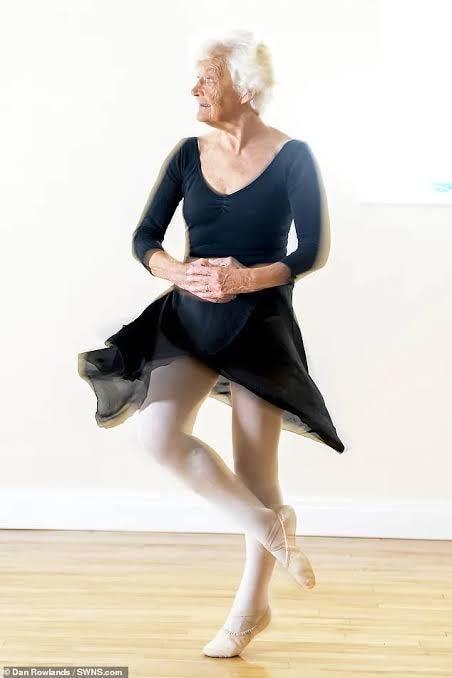
A former modern dancer, Eda stands about five feet tall, with bright blue eyes, spiky white hair, pug nose, and age spots dotting her face and arms. She moves energetically—no aches or pains, at least none she complains about. On those early visits, we’d walk up the path, through the gardens, arms linked. Eda would point out the names of each flower along the way.
She explained how the community is organized: when residents are no longer able to be independent, they move into assisted living, where they’re monitored more closely. If they become ill, they move to the nursing unit. “There’s nowhere to go after that,” she’d say, laughing. It would be a couple more years before she had to leave the townhouse.
Eda is happy to have a lunch companion who isn’t deaf. And I feel like I’m doing a mitzvah, a good deed. “Half the people can’t hear,” she says. “It’s like eating with cadavers!” But she makes the effort to join the other residents nevertheless. When I’m with her, we sit close together and talk animatedly about politics, philosophy, religion, current events. She reports on her latest readings—the history of homo sapiens or a treatise on astronomy.
***
It is a mitzvah, I suppose. But all acts of compassion are in some way self-serving. With Eda, I get to experience myself as a good, loving, selfless daughter—ever available and kind, at least for those few hours. She’s a friend. But it’s also like having a good Jewish mother, with no strings attached. Sometimes I even visualize my mother’s face in hers and imagine what it would be like to feel so connected, to hold my mother’s gaze so easily, without feeling the familiar, ancient surge of inadequacy and resentment.
Sometimes I look around at the white-haired ladies, for the residents are mostly women who’ve outlived their husbands, and wonder, Will I end up alone in a place like this? Will I have to depend on strangers to care for me? Who will come to visit? My family is small. My parents, in their early nineties, and my widowed aunt, eighty-eight, will be gone soon. I have a brother, Donnie, and sister-in-law, Joanna; two cousins, one nephew and niece, all of whom are scattered around the East Coast. We get together only occasionally now, as coordinating our busy schedules is an arduous undertaking. What will happen when all the parents are gone? Who will outlive whom?
“This isn’t living, it’s existing,” Eda would always say. Yet every day for a long time she’d wake up, get dressed, read the newspapers, and participate in events, especially screenings of live opera or classic films.
“How do you do it?” I’d say. “If I felt that way, I’d just curl up into a ball and cry.”
“Well, Ducky,” she’d say, “you just go on, because you have to. What choice is there?”
***
I think a lot about choices. Growing up, I imagined a successful career, marriage, children, grandchildren—the script. Now I’m in my early sixties. I’ve lived alone for most of my adult life. I’ve juggled careers as a writer, editor, and therapist, restlessly at first, now more happily. I never met a man I’d want to marry, never chose to have a child alone. If I live into my nineties, what will I have built? What memories will I have, if I have a memory at all?
Unlike Eda, my mother has a low threshold for discussions of mortality. For years, on the rare occasions when my brother and I visited my parents together—maybe a family birthday or Thanksgiving or Passover—we tried to initiate “the talk”: where are their papers, what are their wishes, what do they want to do about sixty-plus years’ worth of stuff? And for years, my mother refused. “I don’t need this kind of stress,” she’d say. “It’s a holiday, for God’s sake, it’s not a good time.” “Don’t upset your mother,” my father would chime in. Once, she said, “You can find everything in my computer in a folder called ‘Just in Case.’” The folder, it turns out, contains a list of what readings and music she wants at her funeral, in precise detail. On one visit, not long ago, my father had typed up a list of all the important information and shared it with me, Donnie, and Joanna. My mother sat silently at the dining room table, fidgeting with a box of restaurant matches.
The next day, she agreed to take me on a tour of her jewelry drawer. “I should know, Mom, so if some appraisers come in and want to rip us off, I’ll have some idea of what you have.” We made no eye contact as she rummaged through small cardboard boxes and plastic baskets and velvet pouches tied with drawstrings. The ruby ring from Grandma Charlotte, the charm bracelet Daddy gave her on their tenth anniversary, the pearls from Russia, the turquoise from Israel. Nothing very valuable, but I was grateful and I told her as much. She grasped my hands in hers, looked into my eyes, and said, “Of course, sweetheart, you should know about these things.”
I shot this video a few months before Mom died. I sold some, gave some to my sister-in-law and niece, and kept a few things for myself.
***
Eda has her affairs in order. Her children know exactly where everything is; all financial and legal details have been attended to as she waits to die. Her son, Nathan, and his wife live in Atlanta. Her daughter, Sarah, who never married either, lives in the Boston area with her adopted daughter. “Now that’s being alive! When I’m with family. The rest?” Eda once said, surveying the dining room with a sweep of her arm. “Dull, dull, deadly dull.”
One time, in the townhouse years, I arrived and she wasn’t waiting outside the café, where we usually met. I sprinted down the path and entered through the unlocked door, half expecting to find her slumped over in her antique easy chair, but the house was empty. I found her in a group exercise class doing upper-body stretches. “Oh! Debbie! I completely forgot!” she said, bolting off her chair.
As we strode down the hall together, she said, “These people have terrible posture! They don’t know how to hold their bodies or move their arms and hands. Now, you know, I was a dancer, so I know the proper way to hold myself.” She demonstrated, as she had dozens of times, by extending her arms wide, thrusting her chest forward, and tilting her chin up. Then she leaned down, slapped the outside of her thighs, and said, “And I was born with these hips. The original pair.”
Another time, I had left Eda several messages and hadn’t heard back. Then her voicemail was full. The front desk said they couldn’t give out information to non-family members. I contacted Sarah, steeling myself against the possibility that Eda had died and no one had thought to let me know. Sarah reported that Eda had had a minor blood clot and then developed pneumonia—she was in the nursing unit but was expected to do well.
When I visited the next day, Eda was dressed, sitting up, her legs slung over the side of the bed. She said she was disappointed to have survived because now she’d have to move out of the townhouse and into the assisted living building, where she would have less independence. “But they’re right to do it,” she said, gripping my hands. “They know what they’re doing around here. I shouldn’t live alone anymore.” Just the day before her episode, she’d given away Beau, her cat, to a woman with children and acres of land. “I must have known something was going to happen,” she said, “so I made sure Beau would have a happy home. Isn’t that amazing?”
Now that she’s in assisted living, she feels even more confined. One cloudless spring day, we carried our tuna fish sandwiches to a round metal table on the patio. A man slumped in a wheelchair to our left. Eda leaned in and said, “You know, Debbie, I often think that one night I could simply take all of my medications and die in my sleep.”
My stomach contracted. I wondered if, as a licensed social worker and, therefore, a mandated reporter in Massachusetts, I had a legal obligation to tell someone.
“I’m sorry. That’s hard,” I muttered.
“But I would never do it because it would upset the children.” She paused and looked across the croquet court and lush gardens.

“You’ve said you’re not depressed, but it sounds like you are,” I said quietly.
“It’s funny. I think about dying every day, but it’s not depressing to me in the least. If I drop dead tonight, it would be fine. When you leave, I’ll go to my room and I won’t think any more about it. I’ll take a nap and then come down to dinner.”
If she weren’t Jewish, I’d think she was Buddhist. As my mother, now ninety-two, rails against the mere notion of her mortality, here Eda speaks the naked truth. Or rather, her truth. Maybe this is the way it should be. Maybe it is possible to go out peacefully, quietly, with acceptance, not fear or rage.
She pointed to the man in the wheelchair and again lowered her voice, though I’m confident he couldn’t hear us. “But let me tell you something,” she said, leaning forward, her face tightening. “Every single person here thinks about it. But no one talks about it. Ever. They’ll talk about the weather. They’ll talk about the food. Or they won’t talk at all. But it’s on everyone’s mind.” She paused. “I once asked a woman on the staff if the other residents talk to her about it. She said no.”
“What’s it like to talk with me?”
“You’re the only person I can talk to openly.”
“Oh.” I swallowed. “I’m glad.” I felt honored to be her confidante but weighed down by her secrets. “Sarah and Nathan don’t know?”
“Oh God no. I don’t want to worry them.”
After lunch, I walked her back to her room. She handed me a color printout of a recent photograph I’d given her of my parents—Dad is holding a framed picture of Mom in her World War II Army uniform. Mom is holding one of Dad in his Navy uniform. The photo had appeared in a Columbia University alumni magazine.
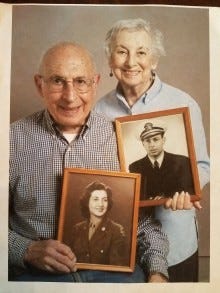
“I remember them!” she said brightly, staring into my eyes. “You look just like your father.” She paused, then shoved the paper toward me. “Here, take it.”
“Oh no, that’s for you to keep.”
“No! I don’t want it,” she said, suddenly agitated. “It’s just more to hang on to.”
***
Before her husband became ill, some years back, they’d sold their house and divested fifty percent of everything they owned. Then, after Howard’s death, Eda got rid of almost everything else. After she entered assisted living, she had methodically arranged to donate her belongings from the townhouse. Now in a tiny but sunny single room overlooking the courtyard, she has little remaining from her past. Just a desk, a bed, a dresser, a TV, some items of clothing, and a few pieces of Asian art acquired on one of the many international journeys of her former life, none of which she can remember.
“Tell me,” she asks whenever we meet, “how are your parents? Do they have medical problems? Are they still living in their house? Do they drive?”
I tell her my parents are doing fine, though they have their aches and pains. My dad still drives, but his eyesight is failing. They go food shopping, take books out from the library, attend concerts and lectures, participate in a seniors’ study group at their synagogue, and travel to their many doctors’ appointments.
“They are so lucky. They still have each other,” she says. “If one of them goes, everything will change.”
“I know.
“Have they cleaned up yet?” she asks. I’ve told her that every corner of my parents’ house is packed. They occasionally gather some newspapers to toss into the recycling bin. My father even hired a helper to sort through his study, whose shelves are warped from the weight of hundreds of books about the Soviet Union. They laugh about it, but I know it will be left to me and Donnie to deal with the clutter.
“They’re being selfish, you know,” says Eda.
“I know.”
“That’s their choice, isn’t it? You’ll just have to deal with it when the time comes. I would never do that to my children,” she says. “They have lives of their own, families of their own, careers and obligations. Sarah and Nathan can’t just take a month off to clean up after me.”
Last time I visited my parents, I looked through some small boxes piled underneath a folding table in my old bedroom. One box held dozens of bobbins, another a rainbow assortment of threads; a needle collection, hundreds of buttons, button hooks, iron-on patches, snaps, hooks and eyes, thimbles. Had they been touched in decades? Who would ever use them? Will we just rent a dumpster for the backyard and toss everything into it when the time comes? When will it happen? How will it happen? It’s hard not to fast forward, hard to let go and be in the moment.
Not long ago, I traveled to Connecticut for a long-planned one-day family reunion. My aunt, Joyce, was at Yale-New Haven Hospital with a newly implanted pacemaker. We gathered in a private lounge on the cardiac unit—eleven of us all together, including my parents, my brother and his wife, my cousins, nephew, and niece. Instead of going for a fancy seafood luncheon, as originally planned, we ordered take-out New Haven Pizza, reputedly the best in town, spreading out the pieces on paper towels across a coffee table.
My father removed his bottom teeth and tucked them into a napkin so he could chew better. He uses a walker now, the kind with wheels and a cushiony seat. He has macular degeneration in one eye and one hearing aid, though he really needs two. He told some of the old Soviet-era jokes, as he always does. And we laughed, as we always do. His hands are gnarled from arthritis, his voice hoarse.
My mother wore a tailored olive-green knit pantsuit, taupe turtleneck, and matching amber jewelry. She walked confidently, having had both hips replaced years ago. She asked about my writing. I asked about hers. Later, she reached out to hug me goodbye. Instead of stiffening, I hugged her back, pulling her close. I’m taller than she is now.
Before we parted, we formed a circle and held hands, all eleven of us. We chanted the Shehecheyanu, a prayer invoked on special occasions: Baruch atah Adonai, Eloheinu, melech ha’olam, shehecheyanu, v’kiyimanu, v’higiyanu laz’man hazeh. It means, “Blessed are you, Eternal our God, Sovereign of the universe, who has given us life, sustained us, and helped us to reach this moment.”
***
Eda developed a systemic infection a couple of weeks after her ninety-fifth birthday. Sarah and Nathan called me to her bedside in the nursing unit to say goodbye. She had refused liquids and food. It looked like she would finally have her way. But by the next day, she had changed her mind and started eating again, complaining about the lack of salt. Within a week, she was back in her room, complaining about being alive and waiting to die.
“She’s like the Energizer Bunny,” Sarah said. “She just keeps on ticking.”
“Well, she’s ambivalent,” Nathan said.
Each phone call is the same. Each visit is the same, with one exception. The last time we had lunch, she insisted on taking the stairs to her room instead of the elevator.
“You sure?” I asked.
“Oh yes,” she said, “and see? I don’t need a walker or cane.”
At the landing, she turned back and smiled. “But I do need the exercise.” Eda moved steadily, one foot per step, swiping her hand along the banister as she ascended.
***
Postscript 2026: Eda died in her sleep at age 98 in 2016. Her medication was all accounted for. My father, Gene, died of complications of pneumonia at age 93 in 2015; my aunt, Joyce, died following a stroke at age 90 in 2017. My mother, Gloria, died in June 2021 at age 99—like Eda, she kept on ticking like the Energizer Bunny until the body finally gave out.
I remember in 2016, following a diagnosis of pneumonia and kidney failure, Mom’s doctor recommended hospice care. Mom said, “I don’t want to go on hospice. I want to go to Marshall’s and get a new pair of pants!” In 2017, she had a successful heart-valve transplant but suffered a small stroke. She recovered fully. Once, in 2018, she complained, as she often did, that her memory was going. So, half-joking, I asked her if she could name the president of the United States, a standard question from the Mental Status Exam. She said, “Unfortunately, yes.”

ESCAPE VELOCITY NEWS
STAY TUNED…
August 20, 7:00 pm, Newtonville Books: Author event with fellow Lesley MFA-er Maida Korte about her debut memoir, Gutted: How An Old House Remodeled Me, and our writing journeys. 10 Langley Rd, Newton Centre.
September 18, 6:00 pm, Books on the Square, Providence, RI: Author event, “In Conversation with Ethan Gilsdorf,” at Books on the Square bookstore, 471 Angell St, Providence. Check out Ethan’s work here.
Future podcast: On June 9, I recorded an interview with the phenomenal Ronit Plank, of the Let’s Talk Memoir podcast. What an interesting and wide-ranging conversation! I’ll link it here in the fall when it airs. If you don’t know Ronit’s work or her Substack, please check it out.
RECENT MEDIA
July 22: My March essay, “From Never to Yes: How and Why I Self-Published My Memoir,” appeared on Andrea Firth’s Brevity Blog Round Up featuring helpful craft essays.
July 2: Featured on Estelle Erasmus’s award-winning podcast, Freelance Writing Direct: “Micro-Memoirs with Maximum Impact: Distilling a Life into Seventy 70-Word Stories.”
Escape Velocity was honored as a Finalist in the 2026 Next Generation Indie Book Awards (Memoirs/Other) category, one of seven books recognized alongside this year’s winner!
June 7: I enjoyed a rich conversation with Alison Cupp Relyea at the Rye Free Reading Room, my hometown. Deep thanks to Alison and everyone who came out! Here’s the online version of Laura Schiller’s feature article, which appeared in the May 22 Rye Record.
May 13: Featured on Jodi Sh. Doff’s new wacky, wonderful series called “Short Attention Span Reader,” where she judges a book by its cover and riffs with the book’s author. So fun! Be sure to subscribe to Jodi’s Substack, “Only the Jodi: Life as a Sober, Aging, Dementia Caregiver.” Good stuff, always.
For more, visit the Media page on my website.
To order Escape Velocity, go to 227 Press, here. For complete info and links, please visit my website.
Hope you’re enjoying my Substack, where I post my musings every Friday. I’m keeping a free subscription option for the foreseeable future, but I’d be grateful if you’d lend your support by subscribing ($7/month or $70/year) and sharing. Much more on my website!
Oh, I loved this. You made me fall in love with Eda, who in my mind was played by an aging Sylvia Sidney. Energizer Bunny indeed. Thank you. This was wonderful and deserved a second life.
You do look like your dad. This was a beautiful story. I felt like I was with you the whole time.
I do worry about the accumulation of stuff, so I've started to thin out material items that I don't need. It's amazing what we hold on to, perhaps as anchors of a longer life.